Most people treat networking like a lottery. They collect business cards, hoping one “ticket” pays off. But effective networking isn’t gambling; it’s Graph Theory.
To build a network that actually generates revenue, we need to combine two mathematical concepts: The Seven Bridges of Königsberg (Route Efficiency) and the Handshake Problem (Connection Potential).
This is the Kant-Handshake Hybrid Model—a step-by-step method to stop wasting time and start calculating ROI.
Part 1: The Theory
The Königsberg Filter (Efficiency)
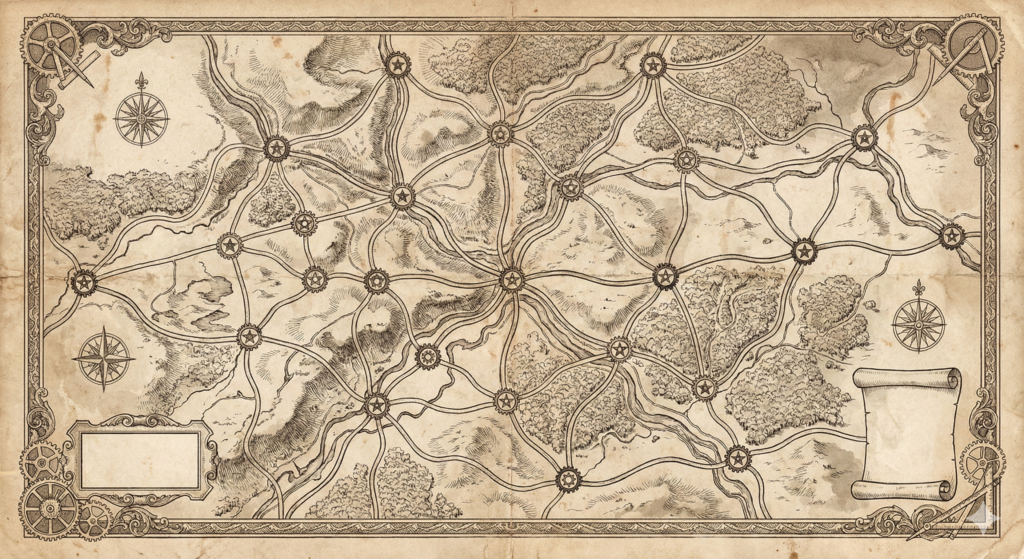
In 1736, Euler proved that it was impossible to cross all seven bridges of Königsberg (Immanuel Kant’s home city) exactly once and return to the start. The lesson? Stop trying to walk every path. In networking, “Breadth” (trying to know everyone) creates dead ends. You cannot cross every bridge without exhausting your resources. You must identify the critical paths.
The Handshake Multiplier (Potential)
Once you select the right path, you apply the Handshake Problem. This concept calculates the total number of unique connections possible in a group. It proves that adding just one high-quality person to your network doesn’t just add one connection; it exponentially increases the potential opportunities available through that node.
The Handshake Formula:
Handshakes = n * (n – 1) / 2
Part 2: The Step-by-Step Hybrid Method
Here is how to execute this hybrid strategy in real life to shift focus from collecting contacts to deepening relationships.
Phase 1: The Audit (The Kant Protocol)
Goal: Stop crossing “dead” bridges.
Instead of random outreach, apply a filter.
- The Action: Review your last 10 networking interactions. Did they lead to a “Strong Tie” (mutual trust) or just a collection of contacts?
- The Math: If you have 500 contacts but only speak to 5, your network density is low. You are crossing bridges that lead nowhere. Cut the noise. Focus on the nodes that offer reciprocity.
Phase 2: Establish High-Quality Ties (The Handshake Mission)
Goal: Convert contacts into Strong Ties through value-driven follow-up.
- The Action: When you meet a new prospect, do not just “connect.” Immediately follow up with a value-add—an article, a book, or a resource they need.
- Real Life Scenario: You meet “Mark,” a potential client.
- The Amateur: Sends a generic “Great to meet you” LinkedIn request.
- The Strategist: Sends a PDF white paper relevant to the problem Mark mentioned over drinks. Mark is now a Strong Tie because you provided immediate value.
Phase 3: The Bridge Builder (The Connector Mission)
Goal: Create a “Bonus Handshake.”
This is where you become the bridge. You look for two people in your network (Node A and Node B) who need each other.
- The Action: Use the Triple Opt-In. Ask Node A if they want the intro. Ask Node B if they want the intro. Then connect them.
- Real Life Scenario: You know Mark needs marketing help. You know “Jane” (another Strong Tie) is a marketing expert. You introduce them. You have now solved Mark’s problem without selling him anything. You are now a valuable hub.
Phase 4: The Calculus of Success (The ROI Mission)
Goal: Measure impact.
Networking is an investment. You must track it like a stock portfolio. Use the following formula to track the monetary value of your time versus the revenue or savings generated by your connections.
The Networking ROI Formula:
ROI = ((Total Value Gained – Total Investment Cost) / Total Investment Cost) * 100
- Total Investment Cost: Cost of the dinner + value of your time.
- Total Value Gained: Revenue from the deal + savings from expert advice + referral value.
Real-Life Case Study: The “Sarah” Loop
Let’s look at “Sarah,” a consultant who applied this hybrid model.
- The Kant Check: Sarah stopped attending generic “mixers” (inefficient bridges) and focused on specific industry leaders.
- The Handshake: She met Mark. Instead of selling, she sent him a resource he needed the next day. Mark became a Strong Tie.
- The Bridge: Sarah connected Mark to Jane for a marketing project.
- The Result: Mark’s company hired Jane. Because Sarah was the “Bridge,” Mark returned the favor by hiring Sarah for an operations contract.
The Bottom Line
The most successful networkers don’t have the most connections; they have the highest ROI from their Strong Ties.
Stop crossing every bridge. Build better ones.
#StrategicNetworking #NetworkingROI #BusinessGrowth #PowerOfConnections #HandshakeProblem #Connector #GraphTheory #MathOfSales