1. Operational Metrics: Establishing the Baseline
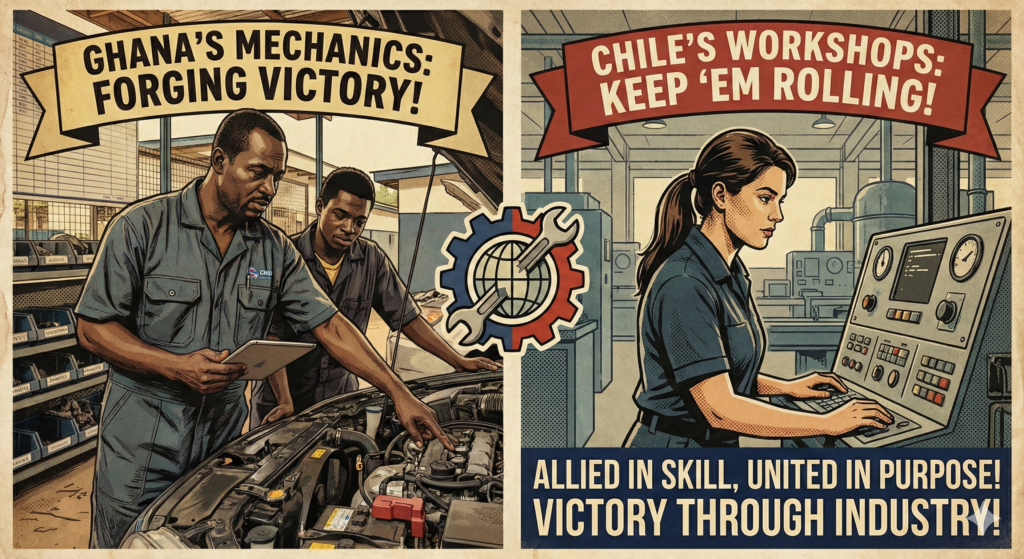
In the U.S., efficient shops do not rely on guesswork; they rely on per-bay ratios. For developing markets in Chile and Ghana, where real estate varies from formal workshops to informal setups, standardization is the first step toward scaling.
The Metric: Daily Car Count & Staffing
- US Benchmark: The average shop processes 2.2 vehicles per bay, per day.
- Staffing Ratio: The US average is 0.7 technicians per bay and 1 service advisor per 3 bays.
Application for Chile & Ghana:
In Ghana, where labor costs are lower but diagnostic equipment may be scarcer, shops should aim for a higher technician-to-bay ratio (e.g., 1.5 techs per bay) to speed up manual labor. However, the 2.2 cars per day metric remains the “Gold Standard” for efficiency. If a shop in Accra has 4 bays but only fixes 4 cars a day (1.0 ratio), they are underutilizing their primary asset.
Correlation Strategy:
- High Volume/Low Tech (Ghana): Increase car count by focusing on “Quick Lube/Tire” models.
- High Tech/Specialized (Chile): Focus on lower car count but higher Average Repair Order (ARO) by servicing complex mining or fleet vehicles.
2. Financial Discipline: The Parts Matrix & ARO
One of the most critical missed opportunities in the US market—and by extension, global markets—is improper parts pricing.
The Method: The Parts Matrix
US data shows that improper parts markup can cost a shop significantly in missed profits annually. A “Parts Matrix” is a tiered pricing structure where lower-cost parts have higher percentage markups, and expensive parts have lower percentage markups.
- US Missed Profit:$40,000 – $70,000 USD.
- Ghana Equivalent: ~455,000 – 796,000 GHS
- Chile Equivalent: ~37,000,000 – 64,800,000 CLP
- The Target: Shops should aim for a 55%–58% Gross Profit (GP) on parts.
- Current Reality: Most shops only hit 32%–44% without a matrix.
Lesson for Global South:
In import-heavy economies like Chile and Ghana, parts costs fluctuate due to currency exchange and tariffs.
- Do: Implement a dynamic Parts Matrix immediately. This protects the shop against currency volatility. If a part costs 560 GHS or 46,000 CLP, the matrix ensures the profit margin remains relative to the cost, securing the supply chain.
- Don’t: Use a flat markup (e.g., “we add 20% to everything”). This kills profit on cheap parts and makes expensive parts uncompetitively high.
Up-Selling vs. Cross-Selling (The Psychology of Sales)
The report highlights that up-selling is not about tricking the customer; it is a “moral and ethical duty to provide honest and detailed information” regarding the vehicle’s health.
- US Insight: 59% of shops cite “Enhanced Customer Experience” as the top driver for higher repair orders, followed by up-selling at 48%.
- The Tool: Digital Vehicle Inspections (DVI). Sending photos/videos of the fault increases authorization rates significantly.
Application:
In markets with lower trust levels, DVI is the “Sigma Truth.” It removes the “mechanic’s word” from the equation and presents visual proof.
- Strategy: In Chile’s mining regions, use DVI to show dust/wear impact on suspension. In Ghana, use DVI to show the difference between a failing “tokunbo” (used) part and a new US-import part to justify the price difference.
3. Human Capital: Building Loyalty and Reducing Turnover
The US is facing a “technician shortage”, a challenge likely to hit Chile and Ghana as vehicles become more computerized and skilled labor emigrates or moves to other industries.
Retention Metrics
US shops found that competitive wages (76%) attract talent, but a positive work environment (69%) is what actually retains them.
The “Career Path” Gap:
- The Problem: 40% of US shops have no career path for techs. This leads to stagnation and turnover.
- The Solution: 48% of successful shops offer “Advancement training and certification”.
Predicting Growth for Apprentices:
To bring on apprentices in Ghana or Chile, do not wait for a labor crisis.
- Partner with Schools: 17% of US shops partner with local programs. Establish pipelines with technical colleges in Kumasi or Santiago.
- Formalize the Path: Create a “Level 1 to Level 3” technician roadmap. Show a young apprentice that in 3 years, they will be a “Master Diagnostic Tech.”
- Financial Transparency: 63% of US shops share financial data with staff to build ownership. Show your team how the shop makes money so they understand their role in it.
4. Future-Proofing: Prevention & EVs
The US market is slowly pivoting to Electric Vehicles (EVs), currently projected to make up 26% of fleet sales by 2035.
The “Tire” Opportunity
- Metric: EV tires wear out 20% faster than gas vehicles due to weight and torque.
- Lesson: For shops in Chile (where EV adoption is accelerating) or Ghana (where hybrid imports are rising), the immediate opportunity is Tire and Suspension maintenance.
- Training: 71% of US techs are not trained on EVs. Global South shops that invest in hybrid/EV safety training now will dominate the market in 5 years.
5. Summary: Lessons Learned
| Category | What TO DO (The Sigma Truth) | What NOT TO DO |
| Operations | Measure “Cars Per Bay Per Day.” Aim for >2.0 efficiency. | Don’t measure success by “busy-ness” alone; measure by throughput. |
| Financials | Use a Parts Matrix to hit 55%+ Gross Profit. Recover the $40k-$70k USD (~455k GHS / ~37M CLP) usually lost. | Don’t use flat-rate markups or emotional discounting. |
| Sales | Use Digital Vehicle Inspections (DVI) to build trust and increase ticket value. | Don’t “sell” repairs; educate the customer on safety and reliability. |
| Staffing | Create a clear Career Path (Apprentice $\to$ Master). | Don’t assume money is the only retainer; culture and respect matter more. |
| Technology | Adopt a Shop Management System (SMS) immediately (97% of US shops use one). | Don’t run a shop on paper. It prevents data tracking and metric analysis. |
Final Recommendation:
For a business entity looking to bridge these markets, the opportunity lies not just in exporting parts, but in exporting “Shop Science.” By providing US-based operational training and management software alongside physical parts, you help Chilean and Ghanaian shops become more profitable, ensuring they can pay for high-quality US exports.