In the life-cycle of every enterprise, there comes a moment where maintenance is no longer enough. Whether you are a solo entrepreneur or leading a large organization, you will eventually face “The Blight”—the slow realization that what worked yesterday is actively harming your tomorrow.
The following story and its business application serve as a framework for knowing when to prune, when to pivot, and when to start over from the roots.
The Story: The Three Cuts
The First Cut: The Branch
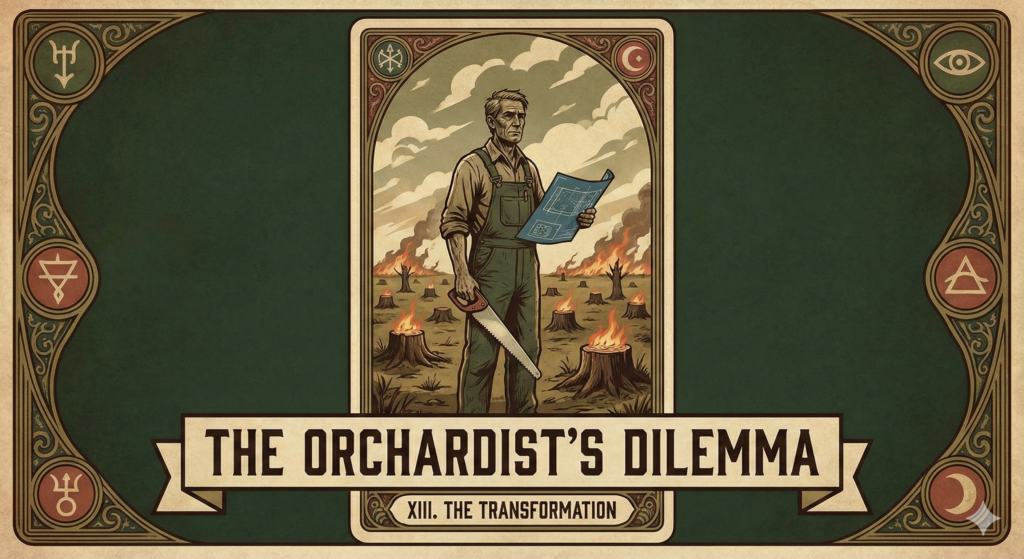
Elias had spent thirty years in his apple orchard. One spring, he noticed a “canker”—a dark, weeping sore on a low-hanging limb of a Northern Spy tree. He felt a pang of worry but told himself it was localized. He took his shears, sterilized the blade, and cut the branch back into healthy wood. He chose to see what he wanted to see: a minor blemish on a perfect history.
The Second Cut: The Tree
By the following season, the fix had failed. The disease had traveled through the vascular system of the tree. The leaves turned brittle, and the fruit shriveled. Elias realized that by trying to save the branch, he had allowed the disease to settle into the heartwood. With a heavy heart, he brought out the chainsaw. He felled the entire tree and burned the wood. It was a painful sacrifice of one to protect the many.
The Final Cut: The Orchard
But the wind and bees do not respect boundaries. The blight was everywhere—hidden by the orchard’s outward beauty but rotting the roots. Elias stood at the edge of his land and faced a brutal truth: the soil and the aging stock were no longer capable of producing life.
He cut down every single tree. To his neighbors, it looked like a tragedy. To Elias, for the first time in years, the land felt light. He had stopped being a “mender” of the old and became the architect of the new.
The Business Application: Identifying the Decay
In business, we often fall victim to the “Sunk Cost Fallacy”—the idea that because we’ve invested time and money into a project, we must keep it alive. Here is how to translate the Orchardist’s journey into your strategy:
1. The Tactical Pruning (The Branch)
This represents a failing marketing channel, a single toxic process, or an under-performing product.
- The Action: Minor adjustments—tweaking ad copy or revising a workflow.
- The Risk: Treating the symptom rather than the root cause. If your “branch” is dying because the market has shifted, pruning won’t help.
2. The Structural Pivot (The Tree)
This is when an entire division or core service is no longer viable.
- The Action: Shutting down a department or ending a major partnership.
- The Strategy: Reallocating capital and energy from the “dying tree” into the healthy parts of the business.
3. The Total Transformation (The Orchard)
This is the “scorched earth” approach. It happens when a business model becomes obsolete.
- The Action: Liquidating old assets and rebuilding the mission from scratch.
- The Philosophy: Acknowledging that the “soil” (your culture or market) needs treatment before anything new can grow.
AI Prompts for Self-Analysis
Use these prompts with an AI (like Gemini) to determine which stage of “cutting” your business requires.
Prompt 1: For the “Branch” (Tactical)
“I have a specific product/service [Insert Name] that is under-performing. Based on [Market Trends/Data], analyze whether this is a temporary fix (pruning) or if it indicates a deeper flaw in my business model. Give me a ‘Prune vs. Pull’ scorecard.”
Prompt 2: For the “Tree” (Structural)
“My business is currently divided into [List Divisions/Services]. [Division X] is draining 80% of my energy for only 20% of the return. Act as a Chief Strategy Officer and walk me through the ‘opportunity cost’ of cutting this ‘tree’ to save the rest of the company.”
Prompt 3: For the “Orchard” (Visionary)
“I feel my entire industry is shifting due to [AI/Economic Changes/Technology]. If I were to start my business today with zero legacy assets but all my current knowledge, how would I build it from the ground up? Help me design a ‘Clear the Field’ transition plan.”
Are you a mender of the old, or the architect of the new?
Most leaders are afraid of the saw.
We hold onto “dying branches”—projects, products, or processes—because of the sweat equity we’ve poured into them. We call it “grit,” but sometimes, it’s just the Sunk Cost Fallacy in disguise.
I recently reflected on the story of the Orchardist’s Dilemma, and it perfectly mirrors the stages of business transformation:
1. The Branch (The Tactical Fix) You see a small problem and you prune it. You tweak the copy, you adjust the workflow. You’re treating the symptom.
2. The Tree (The Structural Pivot) The blight has reached the heartwood. To save the orchard, you have to fell the tree. This is the painful realization that a whole division or service line is no longer viable. You sacrifice one to protect the many.
3. The Orchard (The Total Transformation) This is the hardest cut. It’s when you realize the “soil”—your market or your entire business model—is obsolete. To grow something new, you have to clear the field. You have to be willing to stand in an empty lot and see the potential instead of the loss.
The Hard Truth: The goal of a leader isn’t to save the trees. The goal is to produce the fruit.
If your current “orchard” is no longer producing, stop trying to paint over the decay. Sometimes the most “transparent” and authentic thing you can do for your team and your customers is to start over from the roots.
Which stage are you in right now?
- 🌱 Pruning the branches?
- 🪚 Felling a tree?
- 🔥 Clearing the field for something entirely new?
Conclusion
The hardest part of leadership isn’t growing; it’s letting go. We are conditioned to fear the empty field, but the field must be empty before it can be renewed. Whether you are pruning a branch or clearing an entire orchard, remember: the goal is not to save the trees; the goal is to produce the fruit. Don’t be a manager of decline. Be the architect of what comes next.
#BusinessStrategy #Leadership #Entrepreneurship #Pivot #BusinessTransformation #GrowthMindset #StrategicPlanning #Innovation #TheTransparentVeteran #business #method