
When the global corporate world clocks out for Christmas, the predominant imagery served to us by mainstream media is almost exclusively Northern Hemispheric: roaring fires, ugly sweaters, pine trees heavy with snow, and steaming mugs of cocoa.
While comforting to many, this monochromatic view fails to capture the vibrant, diverse, and profoundly meaningful ways the holiday is celebrated across the Global South.
For millions of people across South America and Africa, Christmas is not about hibernating away from the cold; it is an explosion of summer energy, deep ancestral roots, community feasts, and open-air celebrations.
As global professionals and citizens, understanding these unique customs enriches our cultural intelligence and broadens our perspective on how the world comes together to celebrate family, faith, and community.
Here is a look at some of the unique Christmas customs celebrated across these two vast continents.
South America: The Vibrant “Nochebuena”
In South America, Christmas falls right in the middle of summer. The focus shifts from cozy indoor gatherings to late-night, open-air fiestas. In most Latin American countries, the main event isn’t Christmas Day morning, but Nochebuena (Christmas Eve). Families gather late for massive feasts that often stretch until dawn, culminating in fireworks and dancing.
The traditions here are a fascinating blend of indigenous culture, European Catholicism, and modern vibrancy.
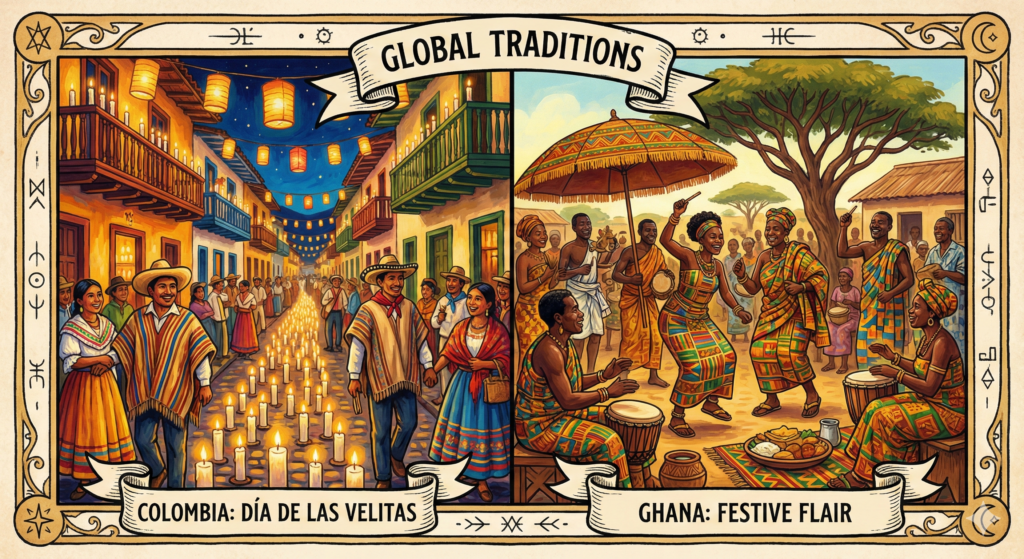
- Colombia’s River of Light: The season officially begins on December 7th with El Día de las Velitas (Day of the Little Candles). Colombians place hundreds of candles and paper lanterns on porches, balconies, streets, and town squares. It is a breathtaking spectacle of light meant to guide the Virgin Mary, turning entire cities into glowing corridors.
- Venezuela’s Rolling Mass: In Caracas, Venezuela, a truly unique tradition takes place. In the days leading up to Christmas, entire neighborhoods wake up early to attend morning mass—but they don’t drive or walk. Streets are closed off so residents can roller-skate to church. It’s a communal, joyous, athletic start to the holy days.
- Peru’s Andean Nativity: In the Andean regions of Peru, the Pesebre (nativity scene) is central, but it is distinctly local. The figures often feature indigenous clothing, and the stable might be populated with llamas and alpacas instead of oxen and donkeys, grounding the sacred story in the local landscape.
Africa: Ancient Roots and Community Feasts
Africa is a vast continent with immense religious and cultural diversity. Christmas traditions here vary wildly from North to South, but a common thread is an intense focus on community, vibrant attire, and hospitality that extends beyond the immediate family.
Christmas in Africa is rarely a quiet, private affair; it is loud, colorful, and communal.
- Ethiopia’s Ancient Observance: Ethiopia, home to one of the world’s oldest Christian churches, follows the Julian calendar. Therefore, they celebrate Christmas, or Ganna, on January 7th. The celebration involves an all-night vigil followed by a day where everyone dresses in a traditional white cotton garment called a shamma. The day often features a traditional game also called Ganna, played with curved sticks and a wooden ball, said to be played by the shepherds when they heard of Jesus’ birth.
- The South African Summer Braai: In South Africa, Christmas is peak summer holiday time. The traditional fir tree might be replaced by an indigenous acacia, and the Christmas roast is often swapped for the beloved Braai (barbecue). Families flock to beaches and parks to grill boerewors (sausage) or seafood in the sun.
- Ghana’s Festive Flair: In Ghana, Christmas is a time of immense joy and homecoming. People travel from cities back to their ancestral villages. Church services are lively, filled with drumming and dancing. Crucially, this is a time for new clothes—families will often coordinate outfits made from vibrant, patterned Ankara or Kente cloth to wear to services and the subsequent feasts.
The Universal Language of Celebration
While a roller-skating mass in Caracas might seem worlds apart from a snowy morning in Chicago, or a beach barbecue in Cape Town different from a quiet dinner in Tokyo, the underlying themes are universal.
These traditions, in all their unique glory, are about pausing the daily grind to connect with loved ones, honor connection, and share food and joy.
As we wrap up the year, let’s appreciate the incredible tapestry of global culture. The world doesn’t celebrate in just one way—and that diversity is something truly worth celebrating.
#ChristmasTraditions #GlobalCulture #DiversityAndInclusion #SouthAmerica #Africa #CulturalIntelligence #Holidays #Community #InternationalBusiness