
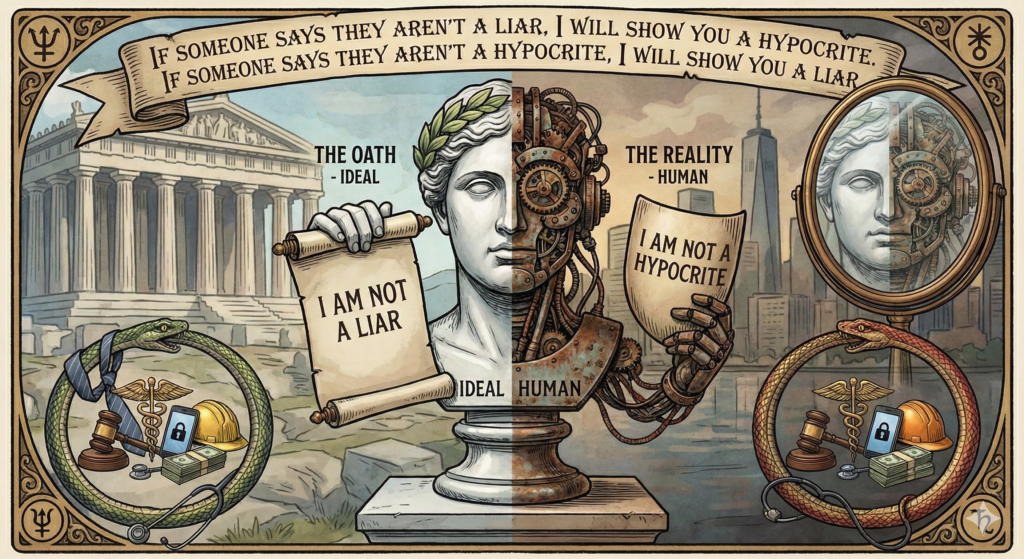
“If someone says they aren’t a liar, I will show you a hypocrite. If someone says they aren’t a hypocrite, I will show you a liar.”
This quote isn’t just a cynical observation; it’s a masterclass in human psychology. In business and in life, we are obsessed with the idea of “integrity,” yet we often ignore the fundamental truth that perfection is an impossibility.
To claim you never lie is a lie in itself. To claim you are never a hypocrite is to ignore your own human inconsistencies.
The Hippocratic Fallacy: Oaths vs. Reality
In many professions, we use Oaths to bridge the gap between human fallibility and the high standards we expect.
The Truth
The medical oath creates a moral North Star—“First, do no harm.” It provides a necessary ethical framework for a profession that holds life and death in its hands.
The Fallacy
The fallacy is the belief that taking an oath makes a person immune to the system they work in. When a doctor is forced by an insurance company to provide “efficient” care over “quality” care, they enter the paradox.
- Psychological Layer: This creates Cognitive Dissonance, where the professional must rationalize their actions to maintain their self-image as a “healer.”
- Sociological Layer: Institutional Capture occurs when the group’s survival (the hospital’s budget) outweighs the individual’s oath.
- Linguistic Layer: Using Euphemisms like “resource optimization” or “care pathways” to mask the reality of service cuts.
11 Real-World Examples of the Integrity Paradox
1. The Medical Burnout Gap
- The Scenario: A physician promotes “holistic wellness” while working 80-hour weeks.
- Psychology: Superiority Bias—believing their medical knowledge makes them immune to the laws of biology.
- Sociology: Professional Martyrdom—a culture where “suffering for the patient” is a badge of honor.
- Linguistics: Using “resilience” as a buzzword to shift the burden of systemic failure onto the individual.
- The Fix: Prioritize practitioner mental health to allow for genuine care.
2. Corporate “Family” Culture
- The Scenario: HR branding claims “Employees are family,” followed by cold layoffs.
- Psychology: Bonding Manipulation—using emotional triggers to increase loyalty and unpaid overtime.
- Sociology: In-group/Out-group Dynamics—”family” language is dropped the moment someone is no longer “useful.“
- Linguistics: Describing layoffs as “right-sizing” or “transitioning talent” to avoid the visceral impact of the word “fired.”
- The Fix: Use transparent communication about business needs instead of “family” tropes.
3. The Financial Fiduciary Trap
- The Scenario: An advisor claims “client-first” while pushing high-commission products.
- Psychology: Self-Serving Bias—subconsciously believing the high-commission product is actually “the best” for the client.
- Sociology: Incentive Alignment—the industry rewards the “closer,” not the protector.
- Linguistics: Using Jargon-Obfuscation to make simple choices seem complex and requiring “expert” (expensive) help.
- The Fix: Shift to fee-only models that align advisor profit with client growth.
4. Big Tech Privacy Claims
- The Scenario: Platforms claim “Privacy is a right” while harvesting and selling user data.
- Psychology: The Privacy Paradox—users say they want privacy but value convenience more, which companies exploit.
- Sociology: Surveillance Capitalism—a society where “free” services are traded for total behavioral tracking.
- Linguistics: Using “personalization” and “user experience” as code for “data mining.”
- The Fix: Implement “Privacy by Design” where total privacy is the default setting.
5. The Green-washing Loop
- The Scenario: A brand markets “Carbon Neutrality” while using unregulated factories.
- Psychology: Moral Licensing—doing one “green” thing gives the company a mental pass to pollute elsewhere.
- Sociology: Virtue Signaling—performing environmentalism for social status rather than ecological impact.
- Linguistics: Vague adjectives like “natural,” “earth-friendly,” or “pure” that have no legal definition.
- The Fix: Provide a public, audited map of the product’s entire supply chain.
6. Legal Technicalities vs. Truth
- The Scenario: A lawyer swears to “seek truth” but suppresses valid evidence on technicalities.
- Psychology: Compartmentalization—separating personal morality from “the job.”
- Sociology: Adversarial System Bias—the goal is winning the “game,” not uncovering the reality.
- Linguistics: The use of Legalese to create a barrier between the “truth” and the “legal record.”
- The Fix: Return to the “spirit of the law” rather than just the “letter.”
7. The “Convenient” Parent
- The Scenario: A parent punishes lying, then asks the child to lie about their age for a discount.
- Psychology: Cognitive Shortcut—the brain prioritizes immediate financial gain over long-term moral consistency.
- Sociology: Social Learning Theory—the child learns that “values” are actually “negotiables.”
- Linguistics: Referring to the lie as “helping the family” or “a little white lie.”
- The Fix: Model integrity by acknowledging the contradiction and explaining the nuance.
8. The “Open Door” Leadership Myth
- The Scenario: A manager boasts an “Open Door” but retaliates against critical feedback.
- Psychology: Fragile Ego Defense—viewing criticism as a personal attack rather than a data point.
- Sociology: Power Distance—the social gap that makes employees fear the “open door.”
- Linguistics: Claiming to want “honest feedback” but only rewarding “constructive alignment.”
- The Fix: Use anonymous reporting tools to remove the fear of retribution.
9. Objective Journalism Bias
- The Scenario: An outlet claims total objectivity while using loaded, emotional adjectives.
- Psychology: Confirmation Bias—journalists (and audiences) seeking information that fits their existing worldview.
- Sociology: Echo Chambers—the group reinforcement of a specific “narrative” as the only truth.
- Linguistics: Loaded Language—using words like “slammed,” “claimed,” or “alleged” to subtly influence the reader’s judgment.
- The Fix: Explicitly state editorial stances or provide a “counter-point.”
10. The Fitness “Natural” Illusion
- The Scenario: An influencer sells supplements while secretly using performance enhancers.
- Psychology: The Halo Effect—if they look healthy, we assume their advice is healthy and honest.
- Sociology: Standard-Setting—creating an impossible body standard that forces others into the same cycle of lying.
- Linguistics: Describing chemically-assisted results as “pure hard work” and “dedication.”
- The Fix: Practice radical disclosure regarding the tools used to achieve a specific look.
11. The “Person of My Word” Flake
- The Scenario: Someone identifies as “highly reliable” but cancels plans at the last minute.
- Psychology: Optimism Bias—the person genuinely believes they can do it all, ignoring past failures.
- Sociology: Conflict Avoidance—saying “yes” in the moment to avoid the social awkwardness of “no.”
- Linguistics: The over-reliance on the passive phrase “something came up” to avoid taking personal agency.
- The Fix: Use the “Under-Promise” Rule—only commit to what you are 100% sure you can do.
Moving Beyond the Paradox
“The goal isn’t to reach a state where you never lie or never act hypocritically—that’s a trap.“
The goal is Radical Accountability. When we admit we have failed our own standards, we stop being liars. When we admit we are capable of hypocrisy, we stop being hypocrites. In business, this looks like Vulnerability-Based Leadership: using your values as a compass you occasionally drift from, rather than a shield to hide your mistakes. Videos about the subject below.
#Integrity #BusinessEthics #Leadership #Accountability #Transparency #HippocraticOath #ProfessionalStandards #HumanPsychology #Sociology #Linguistics #GrowthMindset #RadicalHonesty