
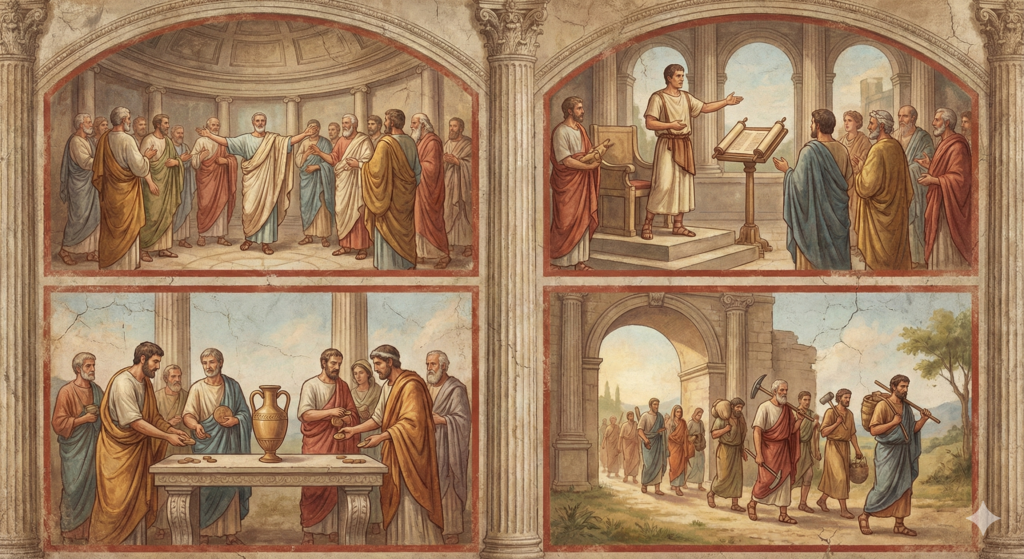
We often complain that modern meetings are unstructured, wandering, or lack a clear “why.” Yet, some of the oldest institutions in human history have maintained engagement and unity for millennia using a very specific four-part structural flow.
Regardless of your personal beliefs, there is a profound organizational psychology at play in the structure of the Roman Catholic Mass. It is a masterclass in change management: gathering a group, aligning them to a message, committing to a shared reality, and sending them out to execute a mission.
Here is how you can apply that same four-part “Liturgy” to transform your next all-hands meeting or client presentation.
Phase 1: The Alignment (The Introductory Rites)
Most business meetings fail in the first five minutes because they dive straight into data without establishing presence.
- The Gathering: Don’t just start the slide deck. Acknowledge the people in the room.
- The “Penitential Act”: Clear the air immediately. If there was a failure last quarter or a looming elephant in the room, address it now. You cannot build progress on unacknowledged tension.
- The Collect: State the singular purpose of this gathering. “We are here today to X.” If you can’t summarize the meeting’s purpose in one sentence, you aren’t ready to lead it.
Phase 2: The Core Message (The Liturgy of the Word)
This is the “instructional” phase, but it shouldn’t be a lecture. It needs to be a narrative.
- The Readings (Data): Present the objective facts. The market reports, the KPIs, the raw numbers. This is the text everyone can see.
- The Homily (Interpretation): This is where leadership happens. Don’t just read the numbers; explain why they matter. Connect the raw data to the team’s daily reality. “We missed the target” is a reading; “Here is how we change our behavior to fix it” is the teaching.
Phase 3: The Commitment (The Liturgy of the Eucharist)
In a religious context, this is where transformation happens. In business, this is where discussion turns into tangible value.
- Preparation of Gifts: What are we bringing to the table? This is the resource allocation phase.
- The Exchange: This is the “buy-in.” A strategy is just a piece of paper until the team mentally and verbally agrees to it. This is the moment the team moves from passive listeners to active participants who share a stake in the outcome.
Phase 4: The Dispatch (The Concluding Rites)
Great meetings often fizzle out at the end. A structured meeting must have a definitive “sending forth.”
- The Blessing: Validate the team. Remind them that they have the capability to solve the problems discussed.
- The Dismissal: Give a clear command to execute. “Go and do X.” The meeting isn’t the work; the meeting is the preparation for the work. The goal is to get people out of the conference room and into the field.
The Takeaway
Structure isn’t about rigidity; it’s about rhythm. By moving your team through these four distinct psychological stages—Alignment, Messaging, Commitment, and Dispatch—you turn a routine meeting into a unified mission.
#Leadership #Management #BusinessStrategy #OrganizationalPsychology #TeamBuilding #EffectiveMeetings #ProfessionalDevelopment